
.png? "Theratio")

-
517,
Suncity Success Tower,
sec 65, Gurgaon,,
Haryana 122018. - info@thesixthelement.in
- +91 9810069803
Concrete Mix Ratio and Proportions Explained
By The Mind of An Architect | May 18, 2026 | Interior Design
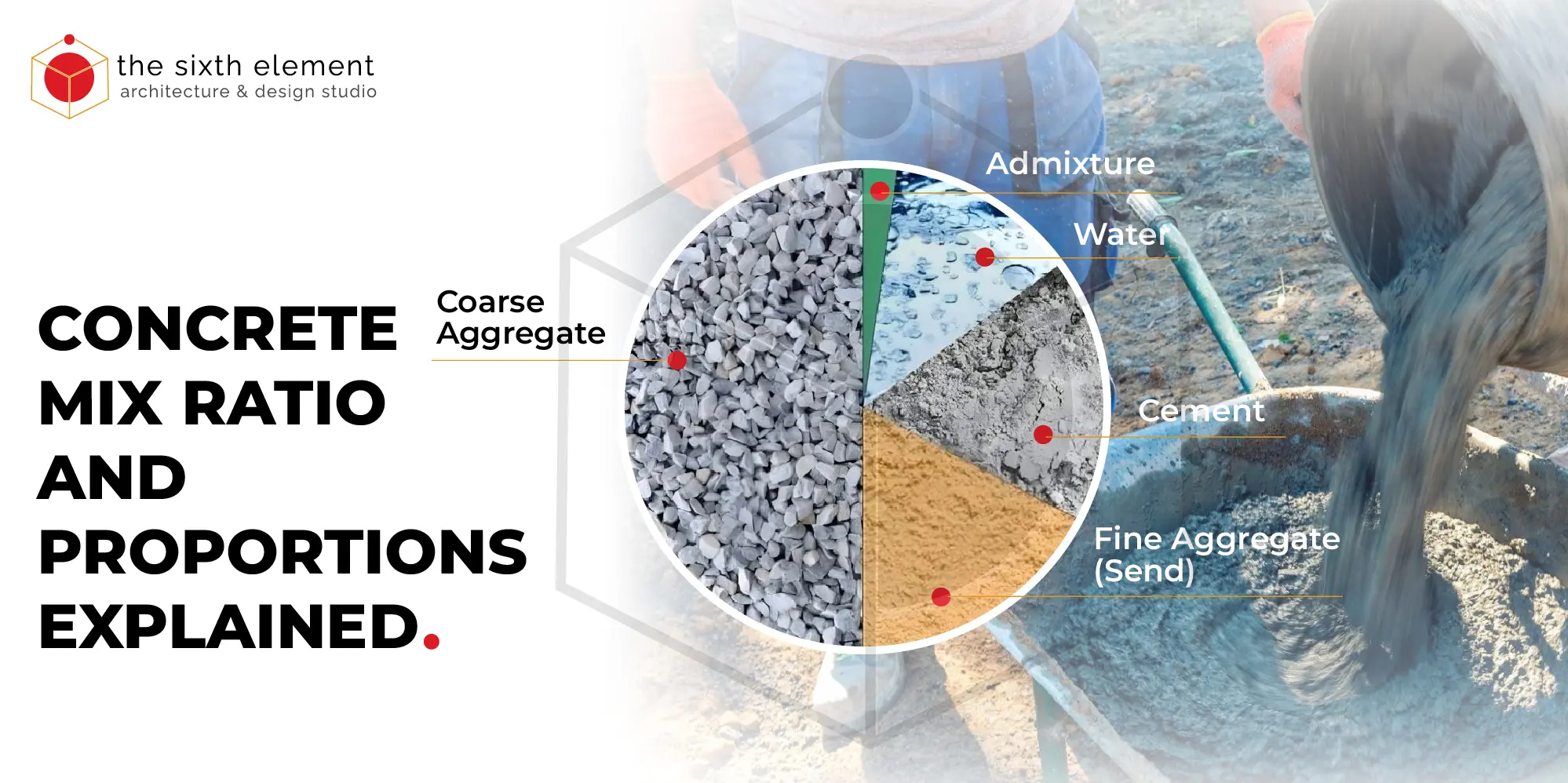
Concrete is one of the most used materials in construction. From house foundations to driveways and slabs, everything depends on the right concrete mix ratio. A proper mix gives strength, supports heavy loads, and helps the surface last longer without early damage.
The basic ratio of concrete includes cement, sand, aggregate, and water. The quantity of each material changes according to the required strength and the type of work.
Common Concrete Ratios Used in Construction
Every structure does not need the same strength. That is why different grades are used for different purposes.
Some commonly used mixes are:
- M10 concrete ratio – 1:3:6
- M15 concrete ratio – 1:2:4
- M20 concrete ratio or m 20 concrete ratio – 1:1.5:3
- M25 concrete ratio – used for stronger structural work
Lower grades are often used in pcc in construction, flooring bases, and small pathways. Higher grades are preferred for beams, slabs, and columns.
Understanding Concrete Mix Design
Many people follow ready-made ratios, but large projects usually require proper concrete mix design. This method helps builders decide the exact quantity of materials based on site conditions and load requirements.
The mix design of concrete depends on:
- Water quantity
- Cement strength
- Aggregate size
- Workability
- Weather conditions
A proper design helps avoid cracks and improves the life of the structure after pouring concrete.
How to Mix Concrete Correctly
Knowing how to mix concrete properly can make a big difference in the final result. Dry materials should be mixed first so the cement spreads evenly through the sand and aggregates. Water should then be added slowly.
Adding too much water weakens the mix and may create surface cracks later. The texture should remain thick and workable, not watery.
For small work, manual mixing is common. On bigger sites, workers usually use a concrete mixer because it saves time and gives a more even blend.
At The Sixth Element, selecting the right concrete mix is treated as an important step because even a small mistake in proportion can affect long-term strength.
How Much Concrete Do You Need?
A common question during construction is, “How much concrete do I need?” The answer depends on the size of the area.
The formula is simple:
Length × Width × Depth = Total Concrete Volume
Once the volume is known, builders can estimate cement bags, sand, and aggregates more accurately. Proper calculation helps reduce waste and keeps the work within budget.
How Long Does Concrete Take to Dry?
People also ask, “How long does it take for concrete to dry?” Concrete begins to harden within a day, but full strength takes time.
In most cases:
- Initial setting happens within 24–48 hours
- Light walking becomes possible after about 7 days
- Full curing strength takes around 28 days
Good curing is important because it helps the concrete gain proper strength and reduces the chances of cracks forming later.
Using the right grade of concrete, correct mixing methods, and proper curing can improve the quality and life of any structure.
FAQs
1. What is the standard concrete mix ratio?
The common concrete mix ratio for M20 grade is 1:1.5:3.
2. Which concrete grade is best for homes?
M20 and M25 grades are widely used for residential construction.
3. Why should extra water be avoided in concrete?
Too much water reduces strength and may cause cracks after drying.
4. Can concrete be mixed without a machine?
Yes, small work can be mixed manually, while larger projects often use a concrete mixer.
5. What is PCC in construction?
PCC in construction refers to Plain Cement Concrete used below structural concrete work.